
Many students know how to run a chi-square test in SPSS, but they get stuck when it is time to write the results in APA style. SPSS gives you tables, values, significance levels, and frequencies, but it does not write the results paragraph for you. This guide explains how to report chi-square test results in APA style using simple language and clear examples. You will learn what values to include, how to format the result, how to report significant and non-significant findings, and how to explain the result correctly.
The guide focuses on two common types of chi-square tests: the chi-square test of independence and the chi-square goodness-of-fit test. By the end, you should be able to turn your chi-square SPSS output into a clear APA-style result that fits an assignment, dissertation, thesis, or research report.
What Is a Chi-Square Test Used For?
A chi-square test is used when your data are categorical. This means the variables are made up of groups or categories rather than numerical scores.
For example, a chi-square test may be used to examine whether:
- Gender is related to preferred learning format
- Smoking status is related to disease status
- Employment status is related to education level
- Product preference differs across age groups
- Students are equally distributed across three program choices
The chi-square test works with frequencies. These are counts of how many cases fall into each category. It does not compare means like a t-test or ANOVA.
There are different types of chi-square tests, but two are the most common in beginner SPSS work. The chi-square test of independence examines whether two categorical variables are associated. On the other hand, the chi-square goodness-of-fit test examines whether one categorical variable follows an expected distribution.
For a deeper background explanation, see our guide on the chi-square test of independence.
What to Include When Reporting Chi-Square Results in APA
A complete APA-style chi-square result should include enough information for the reader to understand what was tested and what was found.
In most cases, you should report:
- The type of chi-square test used
- The variables tested
- The chi-square statistic, written as χ²
- The degrees of freedom, written as df
- The sample size, written as N
- The p-value
- A short interpretation of the result
- Frequencies or percentages when they help explain the finding
The basic APA format is:
χ²(df, N = sample size) = value, p = value
For example:
χ²(2, N = 120) = 8.45, p = .015
This tells the reader the chi-square value, the degrees of freedom, the number of valid cases, and whether the result was statistically significant.
Do not only report the p-value. A sentence such as “The result was significant, p = .015” is incomplete because it does not show the test statistic, degrees of freedom, or sample size.
Basic APA Format for Chi-Square Results
The standard APA-style format for a chi-square result is simple once you understand the parts.
Use this structure:
χ²(df, N = sample size) = chi-square value, p = p-value
Example:
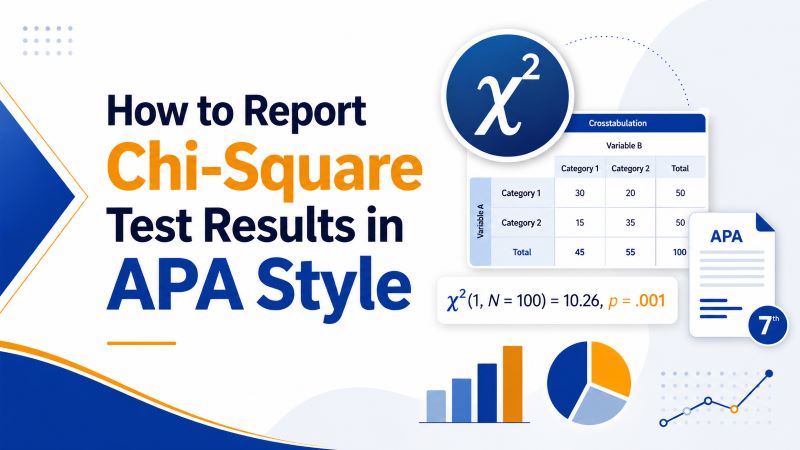
χ²(1, N = 100) = 10.26, p = .001
In a full sentence, you could write:
A chi-square test of independence showed a statistically significant association between gender and preferred learning format, χ²(1, N = 100) = 10.26, p = .001.
Notice that the sentence does more than list numbers. It also tells the reader what the test examined.
When writing in APA style, remember these points:
- Use χ² for the chi-square statistic.
- Put df and N inside the parentheses.
- Report the chi-square value to two decimal places.
- Report exact p-values where possible.
- Write p < .001 if SPSS gives the p-value as .000.
- Italicize statistical symbols such as p and N when formatting your final document.
How to Report a Chi-Square Test of Independence Results in APA
A chi-square test of independence is used when you want to know whether two categorical variables are related. In SPSS, this test is commonly produced through the Crosstabs procedure.
A simple APA template is:
A chi-square test of independence was conducted to examine the association between [Variable 1] and [Variable 2]. The association was statistically significant/not statistically significant, χ²(df, N = sample size) = value, p = value.
If the result is significant, you should add one more sentence explaining the pattern. The chi-square test tells you whether an association exists, but the crosstab helps you explain what the association looks like.
For example:
Female students were more likely to prefer online learning, while male students were more likely to prefer face-to-face learning.
This interpretation should come from the observed counts or percentages in your crosstab. Do not guess the direction based only on the p-value.
If you need the SPSS steps before writing the report, review our guide on how to run a chi-square test of independence in SPSS.
Example 1. Significant Chi-Square Test of Independence Results
Suppose a researcher wants to know whether gender is associated with preferred learning format. The two variables are gender and learning format.
The crosstab is shown below.
| Gender | Online | Face-to-Face | Total |
|---|---|---|---|
| Male | 18 | 32 | 50 |
| Female | 34 | 16 | 50 |
| Total | 52 | 48 | 100 |
The SPSS output gives the following result:
Pearson Chi-Square = 10.26, df = 1, p = .001, N = 100
A correct APA write-up would be:
A chi-square test of independence was conducted to examine the association between gender and preferred learning format. The association between gender and preferred learning format was statistically significant, χ²(1, N = 100) = 10.26, p = .001. Female students were more likely to prefer online learning, while male students were more likely to prefer face-to-face learning.
This result is clear because it reports the test, variables, chi-square statistic, degrees of freedom, sample size, p-value, and interpretation.
Example 2. Non-Significant Chi-Square Test of Independence Results
Not all chi-square results are statistically significant. When the result is not significant, you should report it clearly and avoid overstating the conclusion.
Suppose a researcher examines whether employment status is associated with preferred study mode. The SPSS output gives this result:
Pearson Chi-Square = 3.14, df = 2, p = .208, N = 150
A correct APA write-up would be:
A chi-square test of independence was conducted to examine the association between employment status and preferred study mode. The association between the two variables was not statistically significant, χ²(2, N = 150) = 3.14, p = .208.
This means there was not enough statistical evidence to conclude that employment status and preferred study mode were associated in the sample.
Avoid writing that “there was no relationship at all.” A non-significant result does not prove that no relationship exists in the population. It only means the test did not find a statistically significant association based on the available data.
How to Report a Chi-Square Goodness-of-Fit Test in APA
A chi-square goodness-of-fit test is used when you have one categorical variable and want to compare the observed frequencies with expected frequencies.
For example, you may want to know whether students are equally distributed across three software preferences: SPSS, R, and Excel. If each category is expected to have the same number of students, the goodness-of-fit test checks whether the observed pattern differs from the expected pattern.
A simple APA template is:
A chi-square goodness-of-fit test was conducted to determine whether [categorical variable] differed from [expected distribution]. The observed distribution was statistically significant/not statistically significant, χ²(df, N = sample size) = value, p = value.
If the result is significant, explain which categories were higher or lower than expected.
The key difference is simple. A chi-square test of independence uses two categorical variables. A chi-square goodness-of-fit test uses one categorical variable and compares it with an expected distribution.
Example 1. Significant Chi-Square Goodness-of-Fit Test Results
Suppose a researcher wants to know whether students are equally likely to prefer SPSS, R, or Excel for data analysis. A total of 120 students are surveyed.
The observed and expected frequencies are shown below.
| Software | Observed Frequency | Expected Frequency |
|---|---|---|
| SPSS | 55 | 40 |
| R | 30 | 40 |
| Excel | 35 | 40 |
| Total | 120 | 120 |
The SPSS output gives this result:
χ² = 8.75, df = 2, p = .013, N = 120
A correct APA write-up would be:
A chi-square goodness-of-fit test was conducted to determine whether students’ preferred statistical software was equally distributed across SPSS, R, and Excel. The observed distribution differed significantly from an equal distribution, χ²(2, N = 120) = 8.75, p = .013. SPSS was selected more often than expected, while R and Excel were selected less often than expected.
This write-up explains both the statistical result and the pattern in the frequencies.
Example 2. Non-Significant Chi-Square Goodness-of-Fit Test Results
Now suppose a researcher wants to know whether students are equally distributed across three preferred class formats: online, hybrid, and face-to-face.
The SPSS output gives this result:
χ² = 1.87, df = 2, p = .393, N = 90
A correct APA write-up would be:
A chi-square goodness-of-fit test was conducted to determine whether students’ preferred class format was equally distributed across online, hybrid, and face-to-face options. The observed distribution did not differ significantly from an equal distribution, χ²(2, N = 90) = 1.87, p = .393.
This means the observed frequencies were not significantly different from the expected frequencies.
When the result is not significant, you usually do not need a long explanation of category differences. A short interpretation is enough unless your assignment or supervisor asks for more detail.
Where to Find Chi-Square Values in SPSS Output
For a chi-square test of independence, most of the values you need are found in the Chi-Square Tests table.
Look for the row labeled Pearson Chi-Square. This row usually gives the main chi-square statistic, degrees of freedom, and p-value.
You should identify:
- Value: This is the chi-square statistic.
- df: This is the degrees of freedom.
- Asymptotic Significance (2-sided): This is the p-value.
- N of Valid Cases: This is the sample size.
You should also check the Crosstabulation table. This table shows the observed counts and, if selected, expected counts and percentages. The crosstab helps you explain the direction of the result.
For a goodness-of-fit test, SPSS usually provides a Test Statistics table. This table gives the chi-square value, degrees of freedom, and significance value. The frequency table gives the observed and expected frequencies.
If you are unsure whether your SPSS output is correct, our SPSS data analysis help service can help with test selection, interpretation, and APA reporting.
How to Interpret the Crosstab Before Writing the Result
The chi-square test tells you whether the association is statistically significant. However, it does not fully explain the pattern. That is why you should look at the crosstab before writing the final interpretation.
Start by comparing the observed counts across categories. Then look at row percentages or column percentages, depending on your research question.
For example, if you are comparing preferred learning format by gender, row percentages may show what percentage of males and females chose each learning format. This makes the interpretation easier to explain.
You should also compare observed counts with expected counts. Large differences between observed and expected counts often contribute to a significant chi-square result.
Be careful with your wording. A chi-square test shows association, not causation. If gender and learning preference are associated, you cannot say that gender caused the learning preference. You can only say that the two variables were statistically associated.
This is one of the most common mistakes students make when writing chi-square results.
Should You Report Effect Size for a Chi-Square Test?
In many assignments, the chi-square statistic and p-value are enough. However, in dissertations, theses, and journal-style reports, it is often better to include an effect size.
The p-value tells you whether the result is statistically significant. The effect size tells you how strong the association is.
For a 2 × 2 chi-square test of independence, the common effect size is Phi, written as φ.
For larger contingency tables, the common effect size is Cramer’s V.
A full APA result with effect size may look like this:
A chi-square test of independence showed a statistically significant association between education level and employment status, χ²(2, N = 180) = 12.46, p = .002, Cramer’s V = .26.
The interpretation should still be simple. You can say that the variables were significantly associated and then describe the pattern using the crosstab.
If your supervisor requires an effect size, do not leave it out. It strengthens your results section and helps readers understand the practical importance of the findings.
How to Report a Chi-Square Table in APA Style
Sometimes a paragraph is enough. However, a table is useful when your crosstab has several categories or when the result is important to your study.
Here is a simple APA-style table example.
Table 1
Relationship Between Gender and Preferred Learning Format
| Gender | Online n (%) | Face-to-Face n (%) | Total |
|---|---|---|---|
| Male | 18 (36.0%) | 32 (64.0%) | 50 |
| Female | 34 (68.0%) | 16 (32.0%) | 50 |
| Total | 52 (52.0%) | 48 (48.0%) | 100 |
Note. χ²(1, N = 100) = 10.26, p = .001.
This table helps the reader see the actual pattern behind the result. It also makes the results section easier to follow, especially when there are multiple chi-square tests.
In APA style, keep the table clean. Avoid unnecessary borders, colors, and repeated information. The table should support the paragraph, not replace it completely.
How to Report Chi-Square Assumptions
Before reporting the result, you should make sure the assumptions of the chi-square test were met. This is especially important in academic assignments, dissertations, and research reports.
The main assumptions are:
- The variables should be categorical.
- The observations should be independent.
- Each case should appear in only one category.
- The categories should be mutually exclusive.
- The expected cell counts should be adequate.
- The data should be frequencies, not means or percentages only.
A simple assumption statement could be:
The assumptions for the chi-square test were checked. The variables were categorical, observations were independent, and expected cell counts were adequate for analysis.
If some expected counts are too small, you may need to report Fisher’s exact test for a 2 × 2 table or consider combining categories if it makes theoretical sense.
Do not ignore assumption problems. A statistically significant result may be misleading if the test assumptions are seriously violated.
For more practical SPSS guidance, you can also read our SPSS help for students page.
Common Mistakes When Reporting Chi-Square Results in APA
Many chi-square reporting errors are easy to avoid once you know what to check.
- Reporting only the p-value. Do not write only “p = .015.” Include χ², df, N, and the p-value.
- Writing p = .000. SPSS may display .000, but APA-style reporting should use p < .001.
- Ignoring the crosstab. A significant result needs interpretation. Use the crosstab to explain which categories contributed to the pattern.
- Claiming causation. Chi-square tests association. They do not prove cause and effect.
- Forgetting the sample size. The sample size should appear inside the parentheses as N = value.
- Using the wrong test name. Do not confuse a chi-square test of independence with a chi-square goodness-of-fit test. They answer different questions.
- Reporting percentages only. Chi-square tests are based on counts. Percentages can help interpretation, but frequencies should not be ignored.
Avoiding these mistakes will make your APA write-up clearer and more accurate.
Step-by-Step Guide to Writing Chi-Square Results in APA
If you already have your SPSS output, use this simple process.
- Step 1: Identify the type of chi-square test. Decide whether you ran a test of independence or a goodness-of-fit test.
- Step 2: Identify the variables. Write down the categorical variable or variables included in the test.
- Step 3: Find the chi-square value. For a test of independence, use the Pearson Chi-Square row in SPSS.
- Step 4: Find the degrees of freedom. Use the df column in the output.
- Step 5: Find the sample size. Use the N of Valid Cases or total valid frequency.
- Step 6: Find the p-value. Use the significance value from the output.
- Step 7: Write the APA sentence. Use the format χ²(df, N = sample size) = value, p = value.
- Step 8: Add interpretation. Explain what the result means in relation to your research question.
This process helps you move from SPSS output to a clear results paragraph.
Copy-and-Paste APA Templates for Chi-Square Results
Use these templates as a starting point. Replace the bracketed sections with your own variables and values.
Significant Chi-Square Test of Independence
A chi-square test of independence was conducted to examine the association between [Variable 1] and [Variable 2]. The association was statistically significant, χ²([df], N = [sample size]) = [value], p = [p-value]. [Briefly explain the pattern using the crosstab].
Non-Significant Chi-Square Test of Independence
A chi-square test of independence was conducted to examine the association between [Variable 1] and [Variable 2]. The association was not statistically significant, χ²([df], N = [sample size]) = [value], p = [p-value].
Significant Chi-Square Goodness-of-Fit Test
A chi-square goodness-of-fit test was conducted to determine whether [categorical variable] differed from [expected distribution]. The observed distribution differed significantly from the expected distribution, χ²([df], N = [sample size]) = [value], p = [p-value].
Non-Significant Chi-Square Goodness-of-Fit Test
A chi-square goodness-of-fit test was conducted to determine whether [categorical variable] differed from [expected distribution]. The observed distribution did not differ significantly from the expected distribution, χ²([df], N = [sample size]) = [value], p = [p-value].
Full APA Write-Up Example
Here is a complete example that brings everything together.
A researcher examined whether gender was associated with preferred learning format among 100 students. The learning format options were online and face-to-face. A chi-square test of independence was conducted to examine the association between gender and preferred learning format. The association was statistically significant, χ²(1, N = 100) = 10.26, p = .001. Female students were more likely to prefer online learning, while male students were more likely to prefer face-to-face learning. This suggests that the preferred learning format differed by gender in the sample.
This paragraph works well because it tells the reader what was tested, reports the correct APA statistics, and explains the result in plain language.
If your study has several chi-square tests, you may report each result in a similar structure. For longer results sections, consider using a table to avoid repeating too many numbers in paragraph form.
When to Seek Help With Reporting Chi-Square Results
Chi-square reporting can feel simple at first, but mistakes are common. Many students are unsure whether they used the correct test, selected the right SPSS output row, checked assumptions properly, or explained the crosstab correctly.
You may need help if:
- You are not sure whether chi-square is the right test
- Your SPSS output has several rows and you do not know which one to report
- Some expected cell counts are too small
- Your supervisor asked for APA-style results
- You need help interpreting significant or non-significant findings
- You have several chi-square tests to report in one results chapter
At SPSSAnalysisHelp.com, we help students and researchers run statistical tests, interpret SPSS output, and write clear APA-style results for assignments, theses, dissertations, and research projects.
You can also explore our data analysis services if you need broader support with statistical analysis and results interpretation.
Conclusion
Reporting chi-square test results in APA style becomes easier when you know what values to include and how to explain them. At minimum, your report should include the type of chi-square test, the variables tested, the chi-square statistic, degrees of freedom, sample size, p-value, and a clear interpretation.
For a chi-square test of independence, remember to use the crosstab to explain the pattern of association. For a goodness-of-fit test, compare the observed frequencies with the expected frequencies. In both cases, avoid overclaiming the result. A chi-square test can show association or distribution differences, but it does not prove causation.
A clear APA write-up should help the reader understand both the statistical result and its practical meaning. Once you master the format, you can report chi-square results confidently in assignments, dissertations, theses, and research papers.
Frequently Asked Questions
Use this format: χ²(df, N = sample size) = value, p = value. You should also state what variables were tested and whether the result was statistically significant.
N refers to the number of valid cases included in the chi-square test. In SPSS, this is often shown as N of Valid Cases.
No. If SPSS shows .000, report it as p < .001. A p-value is not truly zero. SPSS displays .000 because of rounding.
You should report frequencies because chi-square tests are based on counts. Percentages can also be included when they make the interpretation clearer.
It depends on your assignment or research requirements. For stronger academic reporting, include an effect size such as Phi or Cramer’s V.