
Writing a one-way ANOVA results in APA style can feel harder than running the test itself. Many students reach the output stage, see the tables, and then become unsure about what to include, what to leave out, and how to turn numbers into a clear academic paragraph. That is where many marks are lost.
The good news is that APA reporting follows a logical pattern. Once you know what the reader expects, the results section becomes much easier to write. You do not need to copy the whole SPSS output. You only need to report the key statistics in a clean and meaningful way.
This guide explains how to report one-way ANOVA results in APA style in a simple way. You will learn what to include, how to format the result, how to report post hoc tests, how to write non-significant findings, and how to avoid common mistakes. If you still need help with the procedure itself, see our guide on how to run a one-way ANOVA in SPSS.
What One-Way ANOVA Reporting in APA Style Means
A one-way ANOVA is used when you want to compare the means of a continuous outcome across three or more independent groups. The test tells you whether at least one group mean is different from the others. APA style then gives you a standard way to present that result in words and numbers.
In practice, APA reporting is not just about placing an F value and a p value in a sentence. It also involves giving enough context for the reader to understand what was tested and what the result means. That usually includes the group variable, the outcome variable, the group means, the ANOVA statistic, and any follow-up comparisons if the result is significant.
A good APA write-up should be brief, accurate, and easy to read. It should sound like part of a real research report, not like a pasted software output. That is why learning to report one-way ANOVA results properly is important for assignments, theses, dissertations, and journal-style papers.
When this Reporting Format Should Be Used
Before writing the result, it helps to know when this format applies. That way, you do not confuse one-way ANOVA reporting with another test, such as an independent samples t-test or repeated measures ANOVA.
Use this reporting format when:
- You have one categorical independent variable
- The independent variable has three or more independent groups
- You have one continuous dependent variable
- You used a one-way ANOVA to compare the group means
For example, you might compare exam scores across three teaching methods, stress scores across employment categories, or customer satisfaction across three service locations. In each case, the groups are separate, and the outcome is measured on a continuous scale.
If your study has only two groups, you would usually report an independent samples t-test instead. If the same participants were measured more than once, you would need a repeated-measures format. So before writing, make sure the test and design match the reporting style.
What to Include When Reporting One-Way ANOVA Results
Many students make the mistake of reporting too little. They give only the p-value and assume that is enough. In APA style, that is not enough. The reader needs a complete picture of the analysis.
A complete one-way ANOVA APA report should usually include:
- the name of the test
- the dependent variable
- the grouping variable
- the means and standard deviations for each group
- the F statistic
- the degrees of freedom
- the p-value
- the effect size
- post hoc test results if the overall ANOVA is significant
You do not need to include every SPSS table. You also do not need to restate every number shown in the output. The goal is to report the result clearly and efficiently. Think of the APA paragraph as a summary of the most important findings, not as a duplicate of the software output.
When post hoc tests are relevant, they should be mentioned because the ANOVA itself only tells you that a difference exists somewhere among the groups. It does not tell you exactly where that difference lies.
The Basic APA Format for One-Way ANOVA Results
At the center of the write-up is the ANOVA test statistic. APA style usually reports it in this format:
A one-way ANOVA showed that [dependent variable] differed significantly across [groups], F(df between, df within) = value, p = value, effect size = value.
That sentence gives the formal statistical result. After that, you can add descriptive statistics and post hoc findings to make the result more meaningful.
A simple example looks like this:
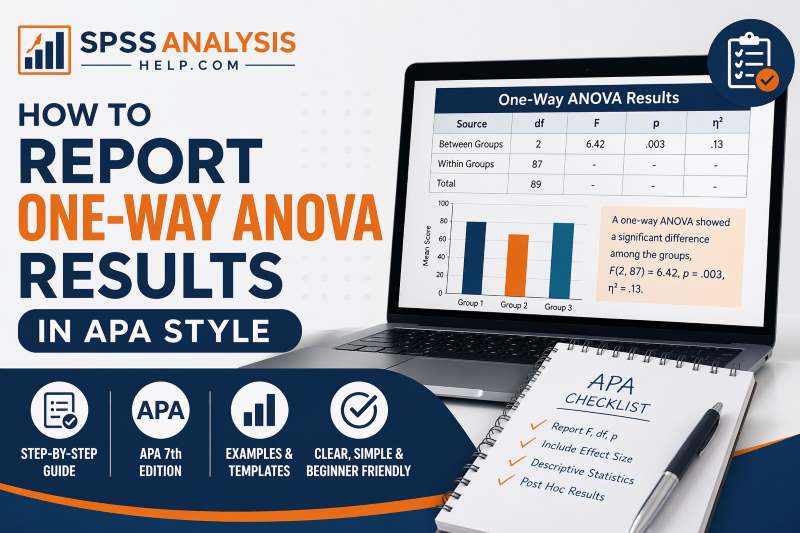
A one-way ANOVA showed that exam scores differed significantly across the three study methods, F(2, 87) = 6.42, p = .003, η² = .13.
This sentence is short, but it includes the main items the reader needs. It names the test, states the dependent variable, identifies the group comparison, and reports the omnibus result.
In APA style, statistical symbols such as F, p, M, and SD are italicized. The p-value is usually written exactly, such as p = .021, unless it is extremely small, in which case you may write p < .001. Also, remember to report the degrees of freedom inside parentheses immediately after the test symbol.
Start With the Variables and Group Descriptives
A one-way ANOVA result is easier to understand when the reader first knows what was compared. That is why it is good practice to identify the dependent variable and the groups before or within the reporting sentence.
For example, instead of writing only that the ANOVA was significant, explain what was tested. You could say that a one-way ANOVA was conducted to examine whether mean anxiety scores differed across first-year, second-year, and third-year students. That small step makes the paragraph much clearer.
It also helps to report the means and standard deviations for each group. These values show the pattern behind the ANOVA result. A significant result tells the reader that the groups differ, but the means show which group appears higher or lower.
A simple way to present descriptives in the text is this:
- Group 1: M = 72.40, SD = 8.15
- Group 2: M = 78.90, SD = 7.82
- Group 3: M = 84.10, SD = 6.95
You can also place these descriptives in a table if that fits your page better. In either case, the reader should be able to see the direction of the group pattern, not just the existence of a difference.
How to Report a Significant One-Way ANOVA Result in APA Style
A significant one-way ANOVA means that at least one group mean is statistically different from another. That is the first thing your report should communicate. But do not stop there. A strong APA report also tells the reader what was being compared and why the result matters.
Here is a clean example:
A one-way ANOVA was conducted to examine whether mean job satisfaction scores differed across three work shifts: day, evening, and night. The results showed a significant difference in job satisfaction among the shifts, F(2, 117) = 5.86, p = .004, η² = .09. Employees on the day shift reported the highest job satisfaction (M = 31.40, SD = 4.21), followed by those on the evening shift (M = 28.90, SD = 4.75), while employees on the night shift reported the lowest scores (M = 27.85, SD = 5.03).
This example works because it does more than announce significance. It identifies the variables, reports the omnibus test, includes effect size, and gives the group means. That makes the finding much more useful to the reader.
If the ANOVA is significant, the next step is usually to report post hoc tests. Without that step, the reader still does not know exactly which groups differ.
How to Report a Non-Significant One-Way ANOVA Result
A non-significant ANOVA should also be reported clearly. Some students feel that a non-significant result is not worth much, but that is not true. It still answers the research question and should be written properly.
Here is an example:
A one-way ANOVA was conducted to determine whether average weekly exercise hours differed across three age groups. The analysis showed that the difference in exercise hours was not statistically significant, F(2, 96) = 1.42, p = .247, η² = .03. Participants aged 18 to 25 reported a mean of 4.80 hours (SD = 1.91), those aged 26 to 35 reported 4.31 hours (SD = 2.04), and those aged 36 to 45 reported 4.02 hours (SD = 1.88).
Notice the wording. The paragraph says the difference was not statistically significant. It does not say the groups were identical, and it does not say the null hypothesis was proven. That is important.
A non-significant result only means the study did not find strong enough evidence to conclude that the group means differed. The means may still vary slightly, but the variation was not large enough to reach statistical significance in that sample.
Why Post Hoc Tests Matter
A one-way ANOVA tells you whether a difference exists somewhere among the groups. It does not tell you which specific groups differ from each other. That is why post hoc tests are often needed after a significant omnibus result.
Think of the ANOVA as the first answer. It tells you that the group means are not all the same. Post hoc tests then give the second answer by showing where the differences are. This is especially important when you have three or more groups, because there are several possible pairwise comparisons.
Common post hoc tests include:
- Tukey HSD
- Bonferroni
- Games-Howell
The choice depends on your data and assumptions. In many student projects, Tukey HSD is common when equal variances are assumed. Games-Howell is often used when that assumption is violated.
In your APA write-up, do not list every post hoc table line unless your instructor asks for that level of detail. Usually, it is enough to report the meaningful comparisons, the direction of the difference, and whether they were statistically significant.
How to Report One-Way ANOVA Post Hoc Results in APA Style
When post hoc tests are needed, they should follow the omnibus ANOVA result in the same paragraph or in the next sentence. The wording should be simple and direct.
Here is an example:
A one-way ANOVA showed that mean test anxiety scores differed significantly across three academic programs, F(2, 102) = 7.14, p = .001, η² = .12. Tukey post hoc comparisons showed that students in Program A (M = 22.18, SD = 4.60) had significantly lower anxiety scores than students in Program C (M = 27.41, SD = 5.12), p = .001. The difference between Program A and Program B (M = 24.30, SD = 4.88) was not significant, p = .118, and the difference between Program B and Program C was also not significant, p = .067.
This is a good model because it does three things well. First, it reports the omnibus ANOVA. Second, it names the post hoc test used. Third, it states clearly which pairs were significantly different and which were not.
You do not need to overload the paragraph with too many numbers. Focus on the comparisons that help the reader understand the pattern of results.
How to Report Effect Size for One-Way ANOVA
A statistically significant result tells you that a difference exists, but it does not tell you how large or meaningful that difference is. That is why effect size is important. In one-way ANOVA, a common effect size is eta squared, written as η².
Effect size helps the reader judge the practical strength of the finding. Two studies can both be significant, but one may show a small difference while the other shows a much larger one. Reporting effect size makes your results section more complete and more professional.
A common way to include effect size is to place it directly in the main ANOVA sentence, like this:
A one-way ANOVA showed a significant difference in performance across the four groups, F(3, 116) = 4.98, p = .003, η² = .11.
That format is clean and easy to follow. If your software reports partial eta squared instead of eta squared, follow the requirement given by your instructor, department, or target journal. The key point is consistency. Do not ignore effect size when it is expected in your course or report.
A Full Example of a Significant APA Write-Up
Sometimes it helps to see the full result as one polished paragraph. The example below shows what a beginner-friendly but academically sound one-way ANOVA report can look like.
A one-way ANOVA was conducted to examine whether mean customer satisfaction scores differed across three service branches. The analysis showed a statistically significant difference in customer satisfaction among the branches, F(2, 147) = 8.26, p < .001, η² = .10. Customers from Branch A reported the highest satisfaction scores (M = 4.31, SD = 0.51), followed by Branch B (M = 4.02, SD = 0.56), while Branch C had the lowest satisfaction scores (M = 3.74, SD = 0.63). Tukey post hoc tests showed that Branch A differed significantly from Branch C, p < .001, and Branch B also differed significantly from Branch C, p = .018. The difference between Branch A and Branch B was not statistically significant, p = .094.
This paragraph is strong because it reads like real research writing. It gives context, reports the main test, includes descriptives, and explains the follow-up comparisons without sounding mechanical.
A Full Example of a Non-Significant APA Write-Up
Non-significant results also deserve a complete and well-written paragraph. A weak write-up can make a proper analysis look careless, even when the statistics were correct.
Here is an example:
A one-way ANOVA was conducted to examine whether average sleep duration differed across three employment categories: full-time, part-time, and unemployed adults. The results indicated that sleep duration did not differ significantly across the three groups, F(2, 111) = 0.93, p = .397, η² = .02. Full-time employees reported a mean sleep duration of 6.82 hours (SD = 1.04), part-time employees reported 7.01 hours (SD = 1.12), and unemployed adults reported 7.15 hours (SD = 1.08).
This example works because it still gives the reader useful information. The result is clearly non-significant, but the paragraph still identifies the groups and shows the pattern in the means.
That is exactly how non-significant results should be handled. They should be reported honestly, clearly, and without overstating what the analysis found.
How to Report One-Way ANOVA Results in a Table
Sometimes a table can improve clarity, especially when you have several groups or want to separate descriptives from the main text. A table is useful, but it should support the paragraph, not replace it.
A simple APA-style table may include:
- group name
- sample size
- mean
- standard deviation
You may also include a short note below the table with the ANOVA result if that fits your formatting style. However, most academic papers still summarize the main result in the text even when a table is included.
For example, the paragraph may say that the groups differed significantly, and the table then presents the means and standard deviations for each group. This combination works well because the text communicates the result while the table gives a clean visual summary.
Avoid copying raw SPSS tables directly into your paper. They are often too detailed, poorly formatted for APA style, and harder for readers to follow. A custom table is usually cleaner and more professional.
Common Mistakes to Avoid
Many reporting problems come from small but repeated mistakes. Once you know them, they are easy to avoid.
Common mistakes include:
- reporting only the p-value and leaving out F and degrees of freedom
- forgetting to mention the dependent variable and group variable
- not reporting group means and standard deviations
- saying the hypothesis was “proved.”
- saying the groups were “the same” after a non-significant result
- reporting a significant ANOVA without giving post hoc results
- pasting SPSS output instead of writing a proper APA paragraph
- mixing one-way ANOVA reporting with repeated measures or independent t-test language
- failing to report the effect size when required
A good final check is to ask this: can a reader understand what was tested, whether the result was significant, how strong the effect was, and which groups differed? If the answer is yes, your paragraph is probably in good shape.
A Simple Fill-in-the-Blank APA Template
Templates can save time, especially when you are still learning. The goal is not to sound robotic, but to give yourself a reliable structure.
Use this template for a significant result:
A one-way ANOVA was conducted to examine whether [dependent variable] differed across [group names]. The analysis showed a significant difference among the groups, F(df between, df within) = value, p = value, η² = value. Group means indicated that [group] had the highest mean (M = value, SD = value), while [group] had the lowest mean (M = value, SD = value). [Post hoc test] showed that [comparison] was significant, p = value.
Use this template for a non-significant result:
A one-way ANOVA was conducted to determine whether [dependent variable] differed across [groups]. The results showed that the difference was not statistically significant, F(df between, df within) = value, p = value, η² = value. The group means were [Group 1 mean], [Group 2 mean], and [Group 3 mean].
This structure is simple, flexible, and suitable for most student papers.
Final Tips for Writing Clearly
Good APA reporting is not only about correct numbers. It is also about clear writing. A strong results paragraph should sound smooth and natural.
Keep these tips in mind:
- Start by naming what was tested
- Report the omnibus ANOVA before post hoc results
- Include means and standard deviations for context
- Use exact p-values unless p < .001
- Keep interpretation factual and modest
- Avoid overexplaining basic statistical ideas inside the results section
- Check your italics and number formatting before submission
If your instructor wants the assumptions discussed in detail, place that in a short sentence before the result or in a separate assumptions section. Do not overload the core APA paragraph unless the assignment requires it.
Also, keep this article focused on reporting. If you still need help producing the analysis in software, read our guide on how to run a one-way ANOVA in SPSS before writing up the results.
When to Seek Help With Reporting One-Way ANOVA Results
Sometimes the analysis is done, but the writing still feels uncertain. That is very common. Students often know whether the ANOVA was significant or non-significant, yet they are not sure how to present it in proper APA format without making mistakes.
You may need help if:
- You are unsure which numbers to extract from SPSS
- You do not know how to report post hoc comparisons
- Your lecturer asked for APA 7 formatting
- You are writing a thesis or dissertation results chapter
- You want your interpretation checked before submission
Getting help at this stage can save time and prevent avoidable errors. A well-written ANOVA result looks simple, but it depends on accurate interpretation, correct formatting, and clear academic language.
Need help with reporting one-way ANOVA results in APA format? Hire SPSS experts today for accurate and reliable results.
Conclusion
Learning how to report one-way ANOVA results in APA style becomes much easier once you know the pattern. You should identify the variables, report the group descriptives, present the F statistic with degrees of freedom and p value, include effect size, and add post hoc results when needed. That gives the reader a complete and professional summary of your findings.
The key is to avoid copying SPSS output and instead translate the result into a short, clear academic paragraph. Whether your result is significant or non-significant, the same principle applies: report the analysis honestly, clearly, and in a way that answers the research question.
If you master this structure, you will find that one-way ANOVA reporting becomes much less stressful. And if you still need help with the procedure itself, be sure to read our related guide on how to run a one-way ANOVA in SPSS.
Frequently Asked Questions
Report the test name, dependent variable, group variable, F statistic, degrees of freedom, p value, effect size, and group means. If the result is significant, also report the post hoc comparisons.
Yes. Means and standard deviations help the reader understand the group pattern behind the ANOVA result. They make the write-up clearer and more informative.
Yes, when the overall ANOVA is significant, and you have three or more groups. The ANOVA tells you that a difference exists, but post hoc tests show which groups differ.
State that the difference was not statistically significant, then report the F value, degrees of freedom, p value, effect size, and group descriptives. Do not say the groups were exactly the same or that the null hypothesis was proven.
Eta squared (η²) is commonly reported in one-way ANOVA. In some contexts, partial eta squared may also be used. Follow the requirements given by your department, lecturer, or target journal.