
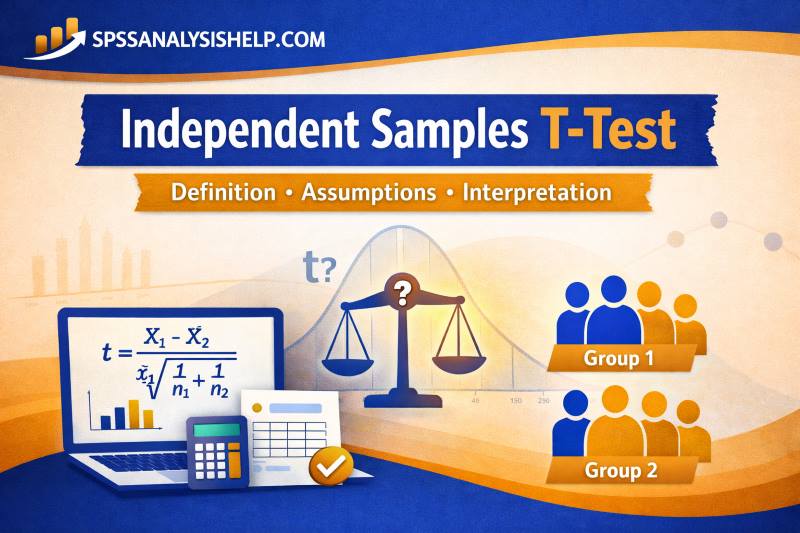
An independent samples t-test compares the means of two independent groups to see if they are significantly different. It is one of the most common tests used in statistics when you want to compare outcomes between two separate groups. In this guide, you will learn when to use the independent samples t-test, the key assumptions you need to check, and how to interpret the results correctly. If you want to apply the test in practice, see our guide on how to run an independent samples t-test in SPSS.
What is an Independent Samples T-Test?
An independent samples t-test helps you determine whether there is a significant difference in the mean of a dependent variable between two independent groups. It shows whether the observed difference between group averages is real or due to random variation.
In this test, you work with:
- Dependent variable: a continuous outcome (e.g., test scores, income, weight)
- Independent variable: a categorical variable with two groups (e.g., male vs female, treatment vs control)
- Independent groups: each subject belongs to only one group
There are two main versions of this test:
- Standard independent samples t-test → assumes equal variances between groups
- Welch’s t-test → does not assume equal variances and works better when variances differ
In SPSS, both versions appear in the output. You choose the correct result based on Levene’s test for equality of variances.
When to Use an Independent Samples T-Test
Use an independent samples t-test when you want to compare the mean values of a continuous variable between two separate and unrelated groups. The goal is to determine whether the difference between the two group means is statistically significant or likely due to chance.
You should use this test when your research question focuses on comparing two distinct groups, such as:
- Comparing test scores between male and female students
- Comparing outcomes between a treatment group and a control group
- Comparing performance across two different classes, schools, or conditions
For the test to be appropriate, the following conditions should be met:
- You have exactly two groups to compare
- The groups are independent, meaning each participant belongs to only one group
- The dependent variable is continuous, such as scores, income, weight, or time
When Not to Use an Independent Samples T-Test
There are situations where this test is not appropriate.
- If the same participants are measured more than once, or if the data are paired or matched, you should use a paired samples t-test instead. This test accounts for the relationship between observations.
- If you need to compare more than two groups, the independent samples t-test is not suitable. In this case, you should use a one-way ANOVA, which allows you to compare means across multiple groups.
- If your outcome variable is categorical rather than continuous, the independent samples t-test cannot be used. A chi-square test is more appropriate for analyzing relationships between categorical variables.
Independent Samples T-Test Assumptions
Before you use an independent samples t-test, you need to check that your data meets certain assumptions. These assumptions affect the accuracy of your results. If they do not hold, your conclusions may be misleading.
Below are the key assumptions you should understand.
1. Continuous Dependent Variable
The dependent variable must be continuous. This means it should be measured on an interval or ratio scale.
Examples include:
- Test scores
- Income
- Weight
- Time
You should not use an independent samples t-test if your outcome variable is categorical. In such cases, a different test, such as a chi-square test, is more appropriate.
2. Independent Variable with Two Groups
The independent variable must be categorical and should divide the data into exactly two groups. These groups must be distinct and unrelated.
Common examples include:
- Male vs female
- Treatment vs control
- Online vs in-store customers
If you have more than two groups, you should not use an independent samples t-test. A one-way ANOVA is more appropriate in that situation.
3. Independence of Observations
The observations must be independent. This means the data in one group should not relate to the data in the other group. Each participant should belong to only one group.
For example:
- A student should not appear in both groups
- One person’s score should not influence another person’s score
You usually confirm this assumption from your study design. If your data involves repeated measures, matched pairs, or the same participants measured more than once, this assumption does not hold. In that case, a paired samples t-test is more suitable.
4. Normality
The dependent variable should be approximately normally distributed within each group. In simple terms, the data should not be heavily skewed and should not contain extreme outliers.
The independent samples t-test can still work well when there are small deviations from normality, especially when sample sizes are large and group sizes are similar. However, strong violations can affect your results.
You can check normality using:
- Histograms
- Q-Q plots
- Statistical tests such as the Shapiro–Wilk test
- Visual inspection for extreme skewness
Normality becomes more important when your sample size is small.
5. Homogeneity of Variance
The variance of the dependent variable should be similar across the two groups. This means the spread of scores in each group should not differ too much.
You can assess this assumption using Levene’s test for equality of variances.
- If Levene’s test is not significant (p > .05), you can assume equal variances
- If Levene’s test is significant (p < .05), the variances are not equal
When variances are unequal, you should use Welch’s t-test. This version adjusts for unequal variances and provides more reliable results.
6. No Significant Outliers
The data should not contain extreme outliers in either group. Outliers can distort the mean and affect the results of the test.
You can check for outliers using:
- Boxplots
- Z-scores
- Visual inspection of the data
If strong outliers exist, you may need to investigate them, remove them if justified, or use a more robust method.
What If Assumptions Are Violated?
If one or more assumptions do not hold, you should be careful when interpreting your results.
- If normality is severely violated, you can use a non-parametric alternative such as the Mann–Whitney U test
- If variances are unequal, you can use Welch’s t-test
- If independence is violated, you should use a paired samples t-test instead
Understanding the Hypotheses in an Independent Samples T-Test
An independent samples t-test is based on two hypotheses. These hypotheses guide the test and help you decide whether a difference between groups is meaningful.
- Null Hypothesis (H₀). The null hypothesis states that there is no difference between the means of the two groups. Any observed difference is assumed to be due to random chance.
- Alternative Hypothesis (H₁). The alternative hypothesis states that there is a difference between the group means. This means the observed difference is likely real.
In many cases, researchers use a two-tailed hypothesis, which tests for any difference:
- H₀: μ₁ = μ₂
- H₁: μ₁ ≠ μ₂
However, in some studies, the alternative hypothesis is directional. This is called a one-tailed test. It tests whether one group’s mean is greater than or less than the other’s.
- H₀: μ₁ = μ₂
- H₁: μ₁ > μ₂ (Group 1 has a higher mean)
- or
- H₁: μ₁ < μ₂ (Group 1 has a lower mean)
In simple terms, the test answers a key question: Are the group means the same, or is one significantly different from the other? The p-value helps you decide whether to reject the null hypothesis.
The T-Test Statistic
The t-statistic is the main value used in an independent samples t-test. It measures how large the difference between the two group means is relative to the variation in the data.
In simple terms, it tells you whether the difference between the groups is large enough compared to the “noise” in the data.
There are two versions of the t-test statistic. The version you use depends on whether the group variances are equal.
i) Equal Variances Assumed
When the two groups have similar variances, you use the standard independent samples t-test. In this case, the test uses a pooled estimate of variance.
The test statistic formula is
Where:
- and are the group means
- n1 and n2 are the sample sizes
- sp is the pooled standard deviation
The pooled standard deviation formula is
This approach combines the variability from both groups into one estimate. It works well when the assumption of equal variances holds.
Equal Variances Not Assumed (Welch’s t-test)
When the group variances are not equal, you should use Welch’s t-test. This version does not pool the variances and provides more reliable results when variability differs across groups.
The test statistic formula for the Welch’s t-test is
Where:
- and are the group means
- and are the group variances
- n1 and n2 are the sample sizes
You do not need to calculate the formula by hand to understand the result.
- A large absolute t-value means the difference between group means is large relative to variability
- A small t-value means the difference is small relative to the variability
The t-statistic works together with the p-value to determine statistical significance.
How to Interpret Independent Samples T-Test Results
Once you run an independent samples t-test, your goal is to understand what the results mean. You want to know whether the difference between the two groups is real and how meaningful that difference is. To interpret the results, follow these steps.
1. Determine Whether the Result Is Statistically Significant
Start by looking at the p-value. This value tells you whether the difference between the group means is likely due to chance.
- If the p-value is less than .05, the result is statistically significant. This means you reject the null hypothesis and conclude that a real difference exists between the groups.
- If the p-value is greater than .05, the result is not statistically significant. This means you do not have enough evidence to conclude that the groups differ.
2. Compare the Group Means
Next, look at the means of the two groups. This helps you understand what the difference actually looks like.
- If the means are close, the difference is small
- If the means are far apart, the difference is larger
Even when a result is statistically significant, you should always check whether the difference is meaningful in practice.
3. Identify the Direction of the Difference
After comparing the means, determine which group has the higher or lower average.
- If Group A has a higher mean than Group B, then Group A scores higher on the outcome
- If Group B has a higher mean, then Group B scores higher
Statistical significance tells you that a difference exists, but the group means tell you where that difference lies.
4. Consider the Size of the Difference
It is also important to understand how large the difference is. A statistically significant result does not always mean the difference is large.
You can assess this by looking at:
- The mean difference, which shows how far apart the group averages are
- The confidence interval, which gives a range of plausible values for the true difference
If the confidence interval does not include zero, it supports the conclusion that a real difference exists.
5. Think About Practical Importance
Finally, ask whether the difference matters in real life. A very small difference can still be statistically significant, especially with large samples.
This is why researchers often report an effect size (such as Cohen’s d) to show the strength of the difference, not just whether it exists.
Quick Interpretation Checklist
To interpret an independent samples t-test, ask yourself:
- Is the result statistically significant (based on the p-value)?
- How different are the group means?
- Which group has the higher mean?
- Is the difference large enough to matter in practice?
Common Mistakes When Using an Independent Samples T-Test
Even though the independent samples t-test is simple, many mistakes can affect your results. Below are common issues you should avoid:
- Ignoring assumptions. Many users run the test without checking whether the assumptions are met. This can lead to misleading results. You should always check independence, normality, and homogeneity of variance before interpreting your findings.
- Using it for more than two groups. The independent samples t-test is designed for comparing only two groups. If your study includes three or more groups, you should use a one-way ANOVA instead. Using the wrong test can produce incorrect conclusions.
- Misinterpreting the p-value. The p-value does not tell you how large or important the difference is. It only tells you whether the difference is statistically significant. A small p-value does not mean the effect is strong. You should also consider the mean difference or effect size.
- Confusing independent and paired tests. This mistake occurs when the data is not truly independent. If the same participants are measured more than once, or if the data is matched, you should use a paired samples t-test instead. Using an independent t-test in this case can invalidate your results.
Conclusion
The independent samples t-test is a simple and widely used method for comparing the means of two independent groups. It helps you determine whether an observed difference is statistically significant or likely due to chance. To use the test correctly, you need to understand when it is appropriate, ensure that key assumptions are met, and interpret the results carefully.
In this guide, you learned what the independent samples t-test is, when to use it, the assumptions behind it, and how to understand the results conceptually. Once you are comfortable with these fundamentals, the next step is to apply the test in practice and report your findings clearly.
If you want to go further, you can learn how to run an independent samples t-test in SPSS and how to report the results in APA style in our related guides.