
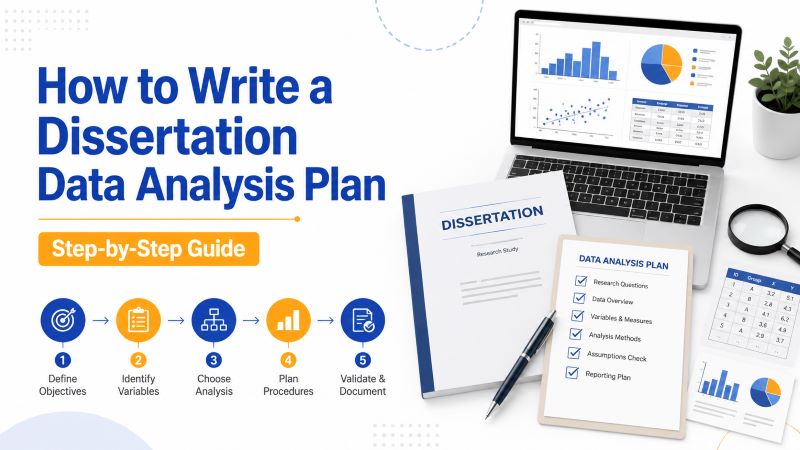
Writing a dissertation data analysis plan can feel difficult when you are not sure where to start. Many students know their topic, research questions, and data collection method, but they struggle to explain how the data will be analyzed.
A data analysis plan gives your dissertation a clear direction. It explains how you will prepare your data, what methods you will use, why those methods are appropriate, and how the findings will answer your research questions.
This plan is usually written before the actual analysis begins. It may appear in your proposal, methodology chapter, ethics application, or research plan. A strong plan helps your supervisor, committee, or examiner see that your study is organized and methodologically sound.
In this guide, you will learn how to write a dissertation data analysis plan step by step. You will also see what to include, how to connect your research questions to the right analysis methods, and how to avoid common mistakes.
However, if you already have your topic, research questions, and dataset but are unsure how to plan the analysis, our dissertation data analysis help service can support you with test selection, analysis planning, data preparation, and results interpretation.
What Is a Dissertation Data Analysis Plan?
A dissertation data analysis plan is a written explanation of how you will analyze the data collected for your study. It shows the steps you will follow to move from raw data to meaningful findings.
The plan does not present results. Instead, it explains what you intend to do before the analysis is completed.
A good data analysis plan usually explains:
- The research questions or hypotheses
- The variables or themes involved
- The type of data collected
- The software that will be used
- The statistical or qualitative methods
- The data cleaning process
- The assumption checks
- The way the results will be reported
For a quantitative dissertation, the plan may include descriptive statistics, hypothesis tests, regression models, ANOVA, correlation, chi-square tests, or other statistical methods. For a qualitative dissertation, it may include coding, theme development, transcript review, and trustworthiness procedures. However, for a mixed methods dissertation, it should explain both the quantitative and qualitative analysis procedures and how the findings will be combined.
Why Is a Data Analysis Plan Important?
A data analysis plan is important because it connects your research questions to your final findings. Without a plan, you may collect data that does not answer your questions or choose a method that does not fit your variables.
A strong plan helps you avoid confusion later. It also shows that your study is not based on guesswork. Every analysis decision should have a clear reason.
For example, if your research question asks whether two groups differ in their mean test scores, your plan should identify the grouping variable, the outcome variable, and the correct statistical test. If your research question asks about the relationship between two continuous variables, your plan should explain why correlation or regression may be suitable.
The plan also helps your supervisor assess whether your study is feasible. If your planned analysis requires a large sample size, special software, or complex modeling, it is better to know this before collecting data.
In short, the data analysis plan protects your dissertation from weak methods, unclear reporting, and avoidable revisions.
Where Does the Data Analysis Plan Go in a Dissertation?
The data analysis plan usually appears in the methodology chapter. In many dissertations, this is Chapter 3. However, the exact structure depends on your university guidelines.
It is often placed after the sections on research design, population, sampling, and data collection. This order makes sense because the reader first needs to understand what data you will collect before you explain how you will analyze it.
A common methodology chapter structure may look like this:
- Research design
- Population and sample
- Data collection method
- Research instruments
- Data analysis plan
- Ethical considerations
- Chapter summary
Some universities use a separate heading called “Data Analysis.” Others may require headings such as “Quantitative Data Analysis,” “Qualitative Data Analysis,” or “Statistical Analysis Procedures.”
Always follow your school’s template first. However, even if the heading names differ, the purpose is the same. You must explain how the data will be prepared, analyzed, and reported.
What Should a Dissertation Data Analysis Plan Include?
A dissertation data analysis plan should be clear, specific, and connected to your research questions. It should not simply say, “The data will be analyzed using SPSS.” That is too vague.
Your reader needs to understand what you will do in SPSS, why you will do it, and how the results will answer the research questions.
Below are the key elements to include.
Research Questions or Hypotheses
Start by restating your research questions or hypotheses. This helps the reader see what the analysis is designed to answer.
For example:
Research Question: Is there a significant relationship between study time and exam performance among undergraduate students?
Hypothesis: There is a significant positive relationship between study time and exam performance among undergraduate students.
This research question suggests that the analysis should examine a relationship between two variables. If both variables are continuous, Pearson correlation or simple linear regression may be appropriate.
Each research question should have a clear analysis method. If a research question does not connect to any analysis, it may need revision.
Variables in the Study
Your plan should identify the main variables in the study. This is especially important in quantitative dissertations.
You may need to describe:
- Independent variables
- Dependent variables
- Control variables
- Demographic variables
- Grouping variables
- Scale or composite variables
You should also mention the level of measurement. This means whether the variable is categorical, ordinal, interval, or ratio.
For example, gender is usually categorical. Age may be continuous or grouped into categories. Satisfaction score from a scale may be treated as continuous if it is created from several Likert items.
Here is a simple structure you can use:
| Research Question | Independent Variable | Dependent Variable | Measurement Level |
|---|---|---|---|
| RQ1 | Study time | Exam score | Continuous and continuous |
| RQ2 | Teaching method | Exam score | Categorical and continuous |
| RQ3 | Gender | Program completion | Categorical and categorical |
This table makes your analysis plan easier to understand.
Type and Source of Data
Your plan should describe the data you will analyze. This gives context to the methods you choose.
You can explain whether the data will come from:
- A survey
- A questionnaire
- Interviews
- Focus groups
- Experiments
- School records
- Hospital records
- Company data
- Secondary datasets
- Online forms
You should also state the expected sample size, unit of analysis, and inclusion criteria.
For example:
The study will use survey data collected from undergraduate students. The unit of analysis will be the individual student. Only participants who complete the main questionnaire items will be included in the final analysis.
If you are using secondary data, explain the source of the dataset and why it fits your research questions.
Data Preparation Procedures
Before analysis, your data must be checked and prepared. This is an important part of the plan because poor data preparation can lead to wrong results.
Your data preparation section may explain how you will:
- Check missing values
- Identify duplicate responses
- Code categorical variables
- Recode variables where needed
- Reverse-code negatively worded items
- Create scale scores
- Check outliers
- Label variables and values
- Screen the dataset for errors
For SPSS-based studies, this step is very important. Many analysis errors happen because variables were coded incorrectly before the test was run.
For example, if your questionnaire has Likert-scale items, you may need to reverse-code some items before creating a total score. If you are unsure how this works, see our guide on how to recode variables in SPSS.
Descriptive Statistics
Most dissertation data analysis plans should include descriptive statistics. These help summarize the sample and the main study variables.
For categorical variables, you may report frequencies and percentages. These may include gender, education level, employment status, or program type.
For continuous variables, you may report the mean, standard deviation, minimum, and maximum. These may include age, test scores, income, stress scores, or satisfaction scores.
A simple statement may look like this:
Descriptive statistics will be used to summarize the demographic characteristics of the participants and the main study variables. Frequencies and percentages will be reported for categorical variables, while means and standard deviations will be reported for continuous variables.
Descriptive statistics help the reader understand the data before inferential tests are presented.
Inferential Analysis Methods
Inferential analysis helps you answer research questions, test hypotheses, or examine relationships in the data.
Your plan should name the specific test or model you will use. More importantly, it should explain why the method is appropriate.
Here are common examples:
| Research Purpose | Possible Analysis |
|---|---|
| Compare two group means | Independent samples t-test |
| Compare one group before and after | Paired samples t-test |
| Compare three or more group means | One-way ANOVA |
| Test association between categorical variables | Chi-square test |
| Examine relationship between two continuous variables | Pearson correlation |
| Predict a continuous outcome | Linear regression |
| Predict a binary outcome | Logistic regression |
For example:
An independent samples t-test will be used to compare mean satisfaction scores between male and female participants.
Is your dissertation SPSS-based? Our SPSS data analysis help service can help you choose and justify the right analysis methods.
Assumption Checks
Many statistical tests have assumptions. Your plan should explain which assumptions will be checked before interpreting the results.
Common assumptions include:
- Normality
- Homogeneity of variance
- Linearity
- Independence of observations
- Absence of extreme outliers
- Absence of multicollinearity
- Adequate expected cell counts for chi-square tests
You do not need to explain every assumption in detail for every possible test. Instead, focus on the assumptions that apply to your planned methods.
For example:
Before running the independent samples t-test, the data will be checked for normality, outliers, and homogeneity of variance. Levene’s test will be used to assess equality of variances.
Software for Data Analysis
Your plan should identify the software that will be used for analysis. Do not mention the software alone. Explain what it will be used for.
For example:
Quantitative data will be analyzed using IBM SPSS Statistics. SPSS will be used to clean the dataset, generate descriptive statistics, test assumptions, and conduct the inferential analyses needed to answer the research questions.
Depending on your study, you may use other tools such as R, Stata, Excel, Python, NVivo, AMOS, or SmartPLS.
Since many dissertation students use SPSS, it is helpful to be specific. You can mention that SPSS will be used for frequency tables, descriptive statistics, correlations, regression, ANOVA, t-tests, chi-square tests, or reliability analysis.
If your full dissertation analysis will be done in SPSS, you may also consider SPSS dissertation help for support with analysis and APA-style results writing.
Reliability and Validity Checks
If your dissertation uses survey scales, your data analysis plan should explain how reliability will be assessed.
For example, if you use several Likert-scale items to measure job satisfaction, stress, motivation, or academic confidence, you may need to test whether those items work together as a scale.
Cronbach’s alpha is commonly used for this purpose.
A simple statement may look like this:
Internal consistency reliability will be assessed using Cronbach’s alpha for each multi-item scale. Items with poor contribution to scale reliability will be reviewed before final scale scores are created.
You should only include reliability testing if it fits your study. If your dissertation uses single-item variables, secondary data, or standardized measures that do not require reliability testing in your project, this section may not be needed.
Sample Size or Power Analysis
Some dissertations require a sample size justification. This explains why your sample is large enough for the planned analysis.
Your approach may depend on your research design, population size, and university requirements.
You may justify sample size using:
- Power analysis
- Population-based sample size formulas
- Prior studies
- Supervisor guidance
- Minimum sample size rules for a specific method
If your population size is known, you may use a formula such as Yamane’s formula. You can read more in our guide on the Yamane formula.
A simple statement may look like this:
The required sample size will be determined based on the study population, desired confidence level, margin of error, and the statistical analyses planned for the study.
Avoid making unsupported claims such as “100 participants is enough” unless you can justify it.
Results Reporting Plan
Your data analysis plan should explain how the results will be presented.
For quantitative studies, this may include:
- Frequency tables
- Descriptive statistics tables
- Correlation matrices
- Regression tables
- ANOVA tables
- Chi-square tables
- Graphs and charts
- APA-style results paragraphs
For qualitative studies, this may include:
- Themes
- Subthemes
- Participant quotes
- Coding summaries
- Thematic tables
The key is to show that results will be reported in relation to each research question.
For example:
The results will be presented using tables and written interpretations. Each research question will be addressed separately, with relevant test statistics, p-values, confidence intervals, and effect sizes reported where appropriate.
This shows that your reporting will be organized and complete.
How to Write a Dissertation Data Analysis Plan Step by Step
Now that you know what to include, the next step is learning how to write the plan in a logical order.
The process below works for many quantitative, qualitative, and mixed methods dissertations.
Step 1: Start With Your Research Questions
Begin by reviewing your research questions. Each question should be clear, focused, and measurable.
Ask yourself:
- What exactly am I trying to find out?
- What data do I need to answer this question?
- Which variables or themes are involved?
- Is the question asking about a difference, relationship, prediction, association, or description?
For example, a question about whether two groups differ requires a different method from a question about whether two variables are related.
If your research questions are vague, your data analysis plan will also be vague. Good analysis planning begins with strong research questions.
Step 2: Match Each Question to the Correct Variables
After reviewing the research questions, identify the variables connected to each one.
For each research question, list:
- The outcome variable
- The predictor or grouping variable
- Any control variables
- The measurement level of each variable
For example, suppose your question is:
Does teaching method affect exam performance?
The teaching method is the independent variable. Exam performance is the dependent variable. The teaching method is categorical, while exam performance is continuous.
This information helps you choose the right test. If the teaching method has three groups, one-way ANOVA may be suitable. If it has only two groups, an independent samples t-test may be suitable.
Step 3: Choose the Analysis Method
Once you understand your variables, choose the analysis method that fits each research question.
Do not choose a test because it sounds advanced. Choose it because it matches your design, variables, and research purpose.
For example:
- Use correlation when you want to examine a relationship between two continuous variables.
- Use chi-square when you want to test the association between categorical variables.
- Use regression when you want to predict an outcome.
- Use ANOVA when you want to compare means across three or more groups.
Your plan should explain the method in simple language.
Example:
Pearson correlation will be used because the study examines the relationship between two continuous variables: academic stress and student satisfaction.
This is stronger than simply saying, “Pearson correlation will be used.”
Step 4: Plan Data Cleaning and Screening
Next, explain what will happen before analysis begins.
This part shows that you understand the importance of data quality. You should not run tests before checking whether the dataset is ready.
You may write:
Before analysis, the dataset will be screened for missing values, duplicate cases, coding errors, and outliers. Categorical variables will be coded numerically, and value labels will be assigned in SPSS. Negatively worded Likert-scale items will be reverse-coded before composite scores are calculated.
This type of explanation is clear and practical. It also shows that your analysis will not be rushed.
Step 5: Add Assumption Testing
After data screening, explain how you will check assumptions for the planned tests.
For example, if you plan to run regression, you may check linearity, normality of residuals, multicollinearity, and outliers.
If you plan to run ANOVA, you may check normality, homogeneity of variance, and outliers.
You do not need to over-explain the technical details in the plan. However, you should show that assumptions will be considered before interpreting results.
Example:
Assumptions for each statistical test will be assessed before final interpretation. Where assumptions are not met, appropriate alternative procedures or cautious interpretation will be considered.
This gives you flexibility while still showing methodological awareness.
Step 6: Explain How Results Will Be Reported
Your plan should end by explaining how you will present the findings.
A dissertation should not just include software output. You must turn the output into tables, paragraphs, and interpretations that answer the research questions.
You may write:
Findings will be reported according to each research question. Descriptive statistics will be presented first, followed by inferential results. Statistical findings will be reported using appropriate test statistics, degrees of freedom, p-values, confidence intervals, and effect sizes where applicable.
If your school requires APA style, mention that results will be written in APA format.
Dissertation Data Analysis Plan Template
You can use the template below as a starting point. Adjust it based on your research design, university requirements, and specific methods.
The data will be analyzed using [software]. Before analysis, the dataset will be screened for missing values, duplicate responses, coding errors, and outliers. Categorical variables will be coded appropriately, and value labels will be assigned where needed. For multi-item scales, relevant items will be reviewed, reverse-coded where necessary, and combined into composite scores after reliability testing.

Descriptive statistics will be used to summarize the sample characteristics and main study variables. Frequencies and percentages will be reported for categorical variables, while means and standard deviations will be reported for continuous variables.

For Research Question 1, [analysis method] will be used because [reason]. The independent variable will be [variable], and the dependent variable will be [variable]. The assumptions of [test] will be assessed before interpreting the findings.

For Research Question 2, [analysis method] will be used to examine [purpose]. Results will be presented using appropriate tables and written interpretations. Findings will be reported in relation to the research questions using relevant test statistics, p-values, confidence intervals, and effect sizes where applicable.
This template is not meant to replace your school’s format. Instead, it gives you a clear structure that you can adapt.
Example of a Dissertation Data Analysis Plan
Below is a simple example for a quantitative dissertation.
Topic: Academic stress, social support, and student satisfaction among university students.
- Research Question 1: What are the levels of academic stress, social support, and student satisfaction among university students?
- Research Question 2: Is there a significant relationship between academic stress and student satisfaction?
- Research Question 3: Does social support predict student satisfaction after controlling for academic stress?
The data analysis plan may be written as follows:
Quantitative data will be analyzed using IBM SPSS Statistics. Before analysis, the dataset will be screened for missing values, duplicate responses, coding errors, and outliers. Negatively worded items will be reverse-coded, and composite scores will be created for academic stress, social support, and student satisfaction. Internal consistency reliability will be assessed using Cronbach’s alpha.
Descriptive statistics will be used to summarize the demographic characteristics of the participants and the main study variables. Means and standard deviations will be reported for continuous variables, while frequencies and percentages will be reported for categorical variables.
Pearson correlation will be used to examine the relationship between academic stress and student satisfaction. Multiple linear regression will be used to determine whether social support predicts student satisfaction after controlling for academic stress. Relevant assumptions will be checked before interpreting the findings. Results will be reported using tables, statistical values, p-values, and written interpretations linked to each research question.
Quantitative Dissertation Data Analysis Plan
A quantitative data analysis plan focuses on numerical data. It explains how variables will be measured, summarized, tested, and interpreted.
This type of plan should clearly identify the statistical procedures that will be used. It should also explain why those procedures fit the research questions.
A quantitative plan usually includes:
- Variable definitions
- Descriptive statistics
- Reliability testing, if needed
- Assumption checks
- Statistical tests
- Software
- Significance level
- Reporting format
For example, you may state that the significance level will be set at .05. This means results with a p-value below .05 will be considered statistically significant, unless your university or field requires another standard.
A quantitative plan should be specific enough for another researcher to understand what analysis will be performed. However, it should not include actual findings. The results belong in the results chapter, not the plan.
If your dissertation involves complex statistical methods, our dissertation statistics help service can help you plan and justify the correct approach.
Qualitative Dissertation Data Analysis Plan
A qualitative data analysis plan explains how non-numerical data will be reviewed, coded, and interpreted.
This may include data from interviews, focus groups, observations, documents, or open-ended survey responses.
A qualitative plan may explain:
- How you will transcribe the interviews
- How you will read and review the data
- How you will develop codes
- How you will identify themes
- How you will select participant quotes
- How you will support trustworthiness
- Which software you will use, if any
For example:
Interview transcripts will be analyzed using thematic analysis. The researcher will first read the transcripts several times to become familiar with the data. Initial codes will then be developed and grouped into broader themes. Representative participant quotes will be used to support each theme.
Qualitative analysis plans should be systematic. Even though qualitative research is flexible, the plan should still show how the researcher will move from raw text to meaningful findings.
Mixed Methods Dissertation Data Analysis Plan
A mixed methods dissertation includes both quantitative and qualitative data. Your analysis plan must explain how each part will be analyzed.
For example, the quantitative part may use survey data and statistical tests. The qualitative part may use interview responses and thematic analysis.
A mixed methods plan should also explain how the two sets of findings will be connected. This is important because mixed methods research is not just two separate studies placed together.
You may write:
Quantitative survey data will be analyzed using SPSS, while qualitative interview data will be analyzed using thematic analysis. The findings from both strands will be compared during interpretation to identify areas of agreement, difference, or expansion.
This shows how the different parts of the study will work together.
If one part of the study is more important than the other, you can also mention this. For example, your study may be mainly quantitative with a small qualitative section used to explain the statistical findings.
Common Mistakes to Avoid
Many students lose marks because their data analysis plan is too general. A strong plan should be specific and connected to the research design.
Avoid these common mistakes:
- Saying “data will be analyzed using SPSS” without explaining the tests
- Listing statistical tests without linking them to research questions
- Choosing tests before defining the variables
- Ignoring the level of measurement
- Forgetting to mention data cleaning
- Leaving out assumption checks
- Writing the plan like a results chapter
- Using advanced methods without justification
- Failing to explain how qualitative data will be coded
- Not following university formatting requirements
The most serious mistake is poor alignment. Your research questions, variables, methods, and reporting plan should all fit together.
For example, if your research question asks about prediction, your method should support prediction. If your question asks about group differences, your method should compare groups.
A good dissertation data analysis plan is not about using the most complicated method. It is about using the right method for your study.
Can You Change the Data Analysis Plan Later?
Yes, a dissertation data analysis plan can sometimes change. However, changes should be reasonable and well-explained.
For example, you may discover that your data does not meet the assumptions for a planned test. In that case, you may need to use an alternative method. You may also need to adjust your analysis if your supervisor gives feedback or if some variables were not collected correctly.
However, you should not change the plan simply to search for significant results. This can weaken the credibility of your dissertation.
If changes are made, explain them clearly in your methodology or results chapter. State what changed and why the change was necessary.
For example:
The original plan was to use Pearson correlation. However, because the normality assumption was not met, Spearman’s rank-order correlation was used instead.
This kind of explanation shows transparency and protects the quality of your work.
Need Help Writing Your Dissertation Data Analysis Plan?
Writing a dissertation data analysis plan can be challenging, especially if you are unsure which statistical test fits your research questions. It can also be difficult when your supervisor asks you to justify your methods, check assumptions, or explain your variables more clearly.
At SPSSAnalysisHelp.com, we help students plan, analyze, and report dissertation data in a clear academic format. We can support you with quantitative, qualitative, and mixed methods studies.
Our support may include:
- Reviewing your research questions
- Identifying the correct variables
- Choosing suitable statistical tests
- Planning data cleaning procedures
- Writing the data analysis section
- Preparing SPSS analysis procedures
- Explaining assumptions
- Interpreting results
- Writing APA-style findings
If your dissertation involves SPSS, statistics, or research data, you can also explore our data analysis help and dissertation and thesis help services.
Final Thoughts
A dissertation data analysis plan is more than a short paragraph in your methodology chapter. It is the roadmap that explains how your research questions will be answered using the data you collect.
A strong plan identifies the variables, describes the dataset, explains data preparation, names the correct analysis methods, checks assumptions, and shows how results will be reported. It also makes your dissertation easier to defend because every method has a clear purpose.
The best data analysis plans are simple, specific, and well aligned. They do not use statistical methods randomly. They connect each research question to the correct data, the correct method, and the correct interpretation.
Before you begin your analysis, take time to write the plan carefully. It can save you from confusion, weak results, and unnecessary revisions later.
Frequently Asked Questions
A data analysis plan is a section that explains how the dissertation data will be prepared, analyzed, interpreted, and reported. It shows the methods that will be used to answer the research questions.
The length depends on the study and university requirements. In many dissertations, the data analysis plan may be several paragraphs to a few pages long. A simple study may need a shorter plan, while a complex quantitative, qualitative, or mixed methods study may need more detail.
Yes, in most dissertations, the data analysis plan appears in Chapter 3, which is usually the methodology chapter. Some universities may use a different structure, so always follow your school’s guidelines.
You should include your research questions, variables, data source, data preparation steps, analysis methods, assumption checks, software, and reporting approach. If your study uses scales, you may also include reliability testing.
Start by looking at your research question, variable types, number of groups, measurement level, and research design. For example, group comparison questions may need t-tests or ANOVA, while relationship questions may need correlation or regression.
Yes, but only when there is a valid reason. For example, you may change the method if assumptions are not met or if supervisor feedback requires revision. Any change should be explained clearly in the dissertation.