
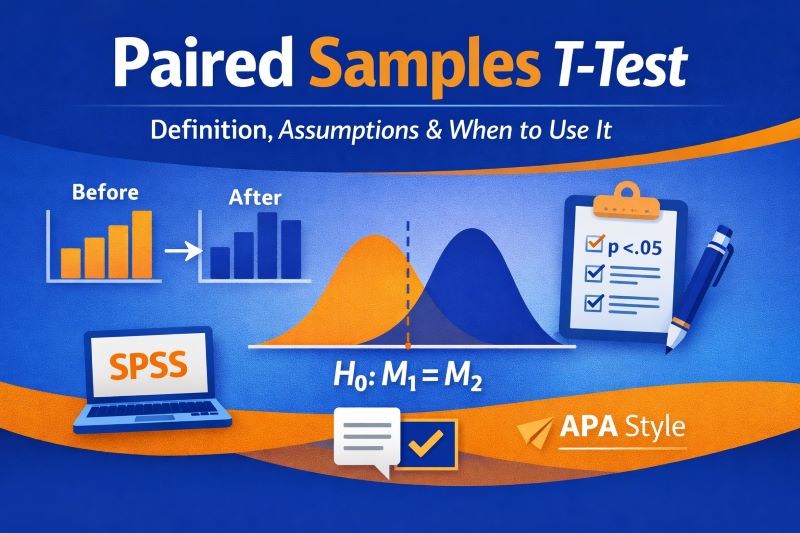
When you need to compare two related measurements, the paired samples t-test is one of the most useful statistical tools you can apply. It helps you determine whether the mean difference between two sets of scores from the same participants is statistically significant. In simple terms, it tells you whether a change happened and whether that change is likely real rather than due to random variation.
This test is common in research involving pre-test and post-test designs, repeated measurements, and matched observations. If you are learning statistics, writing a dissertation, or planning an analysis, understanding the paired t-test is essential because it appears often in health, education, psychology, business, and social science research.
In this guide, you will learn what a paired samples t-test is, when to use it, its assumptions, how it differs from similar tests, and how to interpret the logic behind it. If you want the practical SPSS steps, see our guide on how to run a paired samples t-test in SPSS.
Need help writing up paired samples t-tests findings? Read our guide on how to report paired samples t-test results in APA.
What is a Paired Samples T-Test?
A paired samples t-test is a statistical test used to compare the means of two related measurements. The two measurements usually come from the same participants measured at two different times, or from two observations that are naturally linked.
Because the scores are related, the test focuses on the difference between each pair rather than treating the two sets of scores as independent. That is what makes it different from an independent samples t-test.
You may also hear it called:
- paired t-test
- dependent samples t-test
- Repeated measures t-test for two time points
- Matched pairs t-test
The main goal is simple: to test whether the average difference between the paired observations is significantly different from zero.
For example, a researcher may compare students’ test scores before and after a study program. A clinician may compare blood pressure levels before and after treatment. A business analyst may compare employee productivity before and after a training intervention.
In each case, the same unit is observed twice, and that makes the paired t-test the correct choice.
Why the Paired T-Test Matters
Many real-world studies involve change over time. Researchers often want to know whether an intervention, treatment, training session, policy, or event had an effect. The paired samples t-test is built for that kind of question.
Its strength comes from the fact that it controls for participant-level differences. Since each person is compared to themselves, factors such as intelligence, personality, baseline ability, or personal habits are less likely to distort the comparison. This often makes the paired t-test more powerful than a test that compares separate groups.
That is one reason why pre-test and post-test designs are so common. Instead of asking whether Group A differs from Group B, the paired t-test asks whether the same individuals changed from Time 1 to Time 2.
This test is especially helpful when your research question is centered on improvement, decline, or response to an intervention. If your study design naturally produces linked observations, the paired t-test gives you a direct way to evaluate that change.
Example of a Paired Samples T-Test
Imagine a researcher wants to know whether a revision workshop improves student scores. Twenty students take a test before the workshop and then take a second version of the test after the workshop.
Each student now has two scores:
- a pre-workshop score
- a post-workshop score
Because the same students are measured twice, the observations are paired. The researcher can subtract each student’s pre-test score from their post-test score and analyze whether the average difference is significantly different from zero.
If the post-test scores are consistently higher, the paired t-test may show a statistically significant improvement. If the differences are small or inconsistent, the result may not be significant.
This is one of the clearest examples of when the paired samples t-test should be used.
When to Use a Paired Samples T-Test
Use a paired samples t-test when you have two related measurements, and you want to compare their means.
Common situations include:
- Pre-test and post-test designs, which measure the same participants before and after an intervention
- Repeated measures, which measure the same people at two time points
- Matched pairs designs: pairing individuals based on similar characteristics
- Two conditions on the same participants: such as reaction time under Condition A and Condition B
The key feature is dependence. The observations are not separate. They are linked in a meaningful way.
If the scores come from different participants in two unrelated groups, the paired t-test is not appropriate. In that case, the independent samples t-test is usually the better option.
A quick rule helps here: if each score in one column has a direct partner in the other column, you are likely dealing with a paired design.
Situations Where You Should Not Use It
A paired samples t-test is not suitable for every comparison. It is the wrong choice when the two groups are independent.
For example, do not use it to compare:
- Male students and female students measured once each
- treatment group and control group made up of different people
- customers from one store and customers from another store
Those are independent groups, not paired observations.
It is also not ideal when you have more than two related time points. If you measured the same participants at baseline, 1 month, and 3 months, a repeated measures ANOVA is usually more appropriate.
Another issue arises when your dependent variable is not continuous. If your outcome is categorical, ordinal with very limited categories, or heavily non-normal with severe outliers in a small sample, you may need a different method, such as the Wilcoxon signed-rank test.
Choosing the right test starts with understanding the design of the data, not just the topic of the study.
Paired Samples T-Test vs Independent Samples T-Test
These two tests are often confused, but they answer different kinds of questions.
The paired samples t-test is used when the two sets of scores are related. The same people may be measured twice, or each person in one condition may be matched to a similar person in another condition.
On the other hand, the independent samples t-test is used when the two groups are separate and unrelated. One person belongs to only one group.
Here is the simplest difference:
- Paired t-test: compares change within linked observations
- Independent t-test: compares means across unrelated groups
If you use the wrong one, your results may be misleading because the test assumptions no longer match the study design.
That is why the first question to ask is not “Do I have two means?” but rather “Are these two sets of scores related?”
Paired Samples T-Test vs Repeated Measures ANOVA
A repeated measures ANOVA is used when the same participants are measured more than two times or under more than two conditions. The paired samples t-test is basically the simpler version for exactly two related measurements.
So if your study has:
- Two time points use a paired t-test
- Three or more time points, a repeated measures ANOVA is often better
For example, if you measure stress before therapy and after therapy, a paired t-test works well. But if you measure stress before therapy, midway, after therapy, and again one month later, you need a method that can handle multiple related comparisons without inflating Type I error.
Paired Samples T-Test vs Wilcoxon Signed-Rank Test
The Wilcoxon signed-rank test is a nonparametric alternative to the paired samples t-test. It is often used when the assumptions of the paired t-test are not met, especially when the distribution of difference scores is clearly non-normal, and the sample size is small.
The paired t-test is generally preferred when its assumptions are reasonably satisfied because it uses more information from the data and is often more powerful.
Use the Wilcoxon signed-rank test when:
- The difference scores are strongly skewed
- There are extreme outliers
- The data are ordinal rather than continuous
- The sample is small, and normality is doubtful
In many practical cases, researchers first consider the paired t-test, then switch to the Wilcoxon test only if assumption problems are serious enough to threaten the validity of the results.
What Kind of Variables Do You Need?
To use a paired samples t-test correctly, your data should include:
- one continuous dependent variable
- two related measurements of that variable
The dependent variable should be measured at the interval or ratio level. Common examples include test scores, blood pressure, income, weight, stress scores, reaction time, and performance ratings.
The two measurements usually appear as two separate columns in your dataset, such as:
- Anxiety_Pre
- Anxiety_Post
Each row represents one participant, and the two columns represent the linked observations.
This structure is important because the test works by computing the difference between the two columns for each case.
Null and Alternative Hypotheses
Like other hypothesis tests, the paired samples t-test starts with a null hypothesis and an alternative hypothesis.
The null hypothesis states that the mean difference is zero. In other words, there is no change or no average difference between the two related measurements.
H0: μd = 0
The alternative hypothesis states that the mean difference is not zero. H1: μd ≠ 0 (This is the two-tailed version).
If your study has a strong directional hypothesis, you may use a one-tailed form, but in most academic work, the two-tailed test is the standard choice.
The symbol μd refers to the population mean of the difference scores.
Understanding the hypothesis in this way helps you interpret output correctly. The test is not asking whether one raw mean looks larger than the other. It is testing whether the average difference across pairs is statistically meaningful.
The Formula Behind the Paired T-Test
The paired t-test is based on the sample mean of the difference scores, divided by the standard error of those differences.
The test statistic formula for a paired samples t-test is
Where:
- = mean of the difference scores
- = hypothesized mean difference, usually 0
- = standard deviation of the difference scores
- n = number of pairs
This formula shows why the test depends on the difference scores, not just the two original columns. Once the differences are calculated, the analysis becomes similar to a one-sample t-test on those differences.
That is also why assumption checking focuses on the distribution of the differences rather than the distribution of each original variable separately.
How the Test Statistic Is Interpreted
The t-value tells you how far the observed mean difference is from zero in standard error units. A larger absolute t-value suggests stronger evidence against the null hypothesis.
A positive t-value usually indicates that the first score in the subtraction order is greater than the second, while a negative t-value suggests the opposite. The sign depends on how the software computes the difference, so always check which variable was entered first.
The p-value then tells you whether the observed t-value is statistically significant under the null hypothesis. If the p-value is below your chosen significance level, often .05, you reject the null hypothesis and conclude that the mean difference is statistically significant.
Still, significance alone is not enough. You should also look at the direction of change, the size of the mean difference, and ideally the effect size.
Degrees of Freedom in a Paired T-Test
The degrees of freedom for a paired samples t-test are: df=n−1
Where n is the number of paired observations.
So if you have 25 participants measured before and after an intervention, your degrees of freedom will be: df = 25-1 = 24
This is straightforward because the test is based on a single set of difference scores. Once the differences are calculated, the test behaves like a one-sample t-test performed on those differences.
Knowing the degrees of freedom is important because you will need them when interpreting SPSS output, reporting results in APA style, or checking critical values manually.
Paired Samples T-Test Assumptions
Before using a paired samples t-test, you need to check whether its assumptions are reasonably satisfied. Assumptions matter because they affect whether the p-value and conclusion can be trusted.
The good news is that the paired t-test has fewer assumptions than many other statistical procedures. Still, they should not be ignored.
The key assumptions are:
- The dependent variable is continuous
- The observations are paired or related
- The pairs are independent of other pairs
- The difference scores are approximately normally distributed
- There are no extreme outliers in the difference scores
Many students make the mistake of checking normality for each variable separately and stopping there. For a paired t-test, the most important distribution is the distribution of the difference scores.
Let’s look at each assumption more clearly.
Assumption 1: The Dependent Variable Should Be Continuous
The outcome being analyzed should be measured on a continuous scale. That usually means interval or ratio data.
Examples of suitable variables include:
- test scores
- blood pressure
- weight
- income
- depression scores
- reaction time
A paired t-test is not the right method for nominal outcomes such as yes or no responses. It is also less suitable for highly limited ordinal scales unless the data behave approximately like continuous variables and the design supports that choice.
If your variable is categorical, you should usually choose a different method.
This assumption is often easy to assess because it comes from how the variable was measured, not from a complicated statistical test.
Assumption 2: The Observations Must Be Paired
This is the defining assumption of the paired samples t-test. Each value in one condition must be meaningfully linked to a value in the other condition.
That pairing may happen because:
- The same participant is measured twice
- The same subject is exposed to two conditions
- Two cases are matched based on important characteristics
For example, comparing pre-test and post-test scores for the same students clearly satisfies this assumption. Comparing scores from two unrelated classrooms does not.
If there is no genuine pairing, the paired t-test should not be used. Treating unrelated groups as paired can distort the analysis and lead to incorrect conclusions.
Before running any software procedure, make sure the design itself supports a dependent comparison.
Assumption 3: Pairs Should Be Independent of Other Pairs
Although the two scores within each pair are related, each pair should be independent of every other pair. This means one participant’s paired scores should not influence another participant’s paired scores.
For example, if 30 students each have a pre-test and post-test score, one student’s change should not determine another student’s change. In most standard research settings, this assumption is satisfied by the design.
Problems can arise when data are clustered or nested, such as repeated scores from students inside highly dependent classroom groups, or when one person contributes multiple pairs in a way that violates independence.
In most basic academic applications, this assumption is handled through proper sampling and data collection. It is less about output tables and more about whether the study design was structured correctly.
Assumption 4: The Difference Scores Should Be Approximately Normal
This is one of the most important assumptions for the paired t-test. The requirement is not that each original variable must be perfectly normal. What matters is whether the difference scores are approximately normally distributed.
To check this, create a new difference variable, such as: Difference = Post−Pre
Then assess the normality of that difference variable using:
- histogram
- Q-Q plot
- Shapiro-Wilk test
- skewness and kurtosis
- visual inspection for severe distortion
In moderate or large samples, the paired t-test is fairly robust to mild deviations from normality. The concern becomes stronger when the sample is small, and the difference scores are heavily skewed.
If the difference scores are clearly non-normal and the sample is small, the Wilcoxon signed-rank test may be more appropriate.
Assumption 5: No Extreme Outliers in the Difference Scores
Outliers can have a strong effect on the mean difference and the standard deviation of the differences. Since the paired t-test relies on both, extreme outliers can distort the results.
Again, the key focus is the difference scores, not necessarily the original variables alone. A participant may not look unusual on either raw score, but their change score may still be extreme.
You can check for outliers using:
- boxplots
- stem-and-leaf plots
- z-scores for the difference variable
- careful review of unusual cases
If an extreme outlier is found, do not remove it automatically. First, check whether it is a data entry error, a measurement problem, or a genuine observation. Then decide on the most appropriate action and document it clearly.
Do You Need Equal Variances?
No. This is a common point of confusion.
The paired samples t-test does not require the equal variances assumption that appears in the independent samples t-test. That assumption belongs to comparisons between two unrelated groups.
Because the paired t-test analyzes a single set of difference scores, there is no need to compare variances across separate groups.
This is why SPSS output for the paired t-test does not include Levene’s test. If you see Levene’s test, you are probably looking at an independent samples t-test, not a paired samples t-test.
This distinction is useful for students because it helps avoid importing the wrong assumptions from one t-test page to another.
Do Both Variables Need to Be Normally Distributed?
Not necessarily. What matters most is the normality of the differences between the paired measurements.
This point is often misunderstood. A researcher may look at the pre-test and post-test variables separately, see that one of them is slightly skewed, and assume the paired t-test is invalid. That is not the correct logic.
The paired t-test works on the difference scores. So the right question is:
Are the difference scores approximately normal?
That is the variable the hypothesis test is actually based on. If the difference distribution looks acceptable, the test may still be appropriate even if one original variable is not perfectly normal.
Sample Size Considerations
There is no single minimum sample size that magically makes the paired t-test valid. Still, sample size does affect how sensitive the test is to assumption violations.
With small samples, non-normality and outliers matter more. With larger samples, the test becomes more robust to mild deviations from normality.
In practice:
- Small samples require closer assumption checking
- Moderate and large samples allow more flexibility if the departure from normality is not severe
Researchers should not rely only on formal tests like Shapiro-Wilk, especially with large samples where tiny deviations can become statistically significant. Visual inspection and practical judgment are also important.
One-Tailed vs Two-Tailed Paired T-Test
Most paired samples t-tests in academic writing are two-tailed. That means you are testing whether the mean difference is simply different from zero, without specifying the direction in advance.
A one-tailed paired t-test tests a directional hypothesis, such as whether post-test scores are specifically higher than pre-test scores.
A one-tailed test should only be used when:
- The direction is clearly justified before analysis
- A difference in the opposite direction would not count as support for the hypothesis
In most dissertations, theses, and assignments, the two-tailed version is safer and more widely accepted unless a strong theoretical reason supports a one-tailed test.
How to Describe the Direction of Change
When writing about results, the direction of change matters. A paired samples t-test may show that scores increased, decreased, or did not change significantly.
Here are common ways to describe direction:
- Post-test scores were significantly higher than pre-test scores
- Symptom levels were significantly lower after treatment
- There was no statistically significant difference between Time 1 and Time 2
This is why descriptive statistics should always be reported alongside inferential results. The p-value tells you whether a difference exists, but the means tell you what that difference looks like.
Effect Size and Why It Matters
A statistically significant result does not always mean the effect is large. That is why effect size is important.
For paired t-tests, researchers often report an effect size such as Cohen’s d for dependent samples. Effect size helps show the magnitude of change, not just whether it passed the significance threshold.
In simple terms:
- A small effect may be statistically significant in a large sample
- A moderate or large effect may still be useful even if the sample is limited
Common Mistakes Students Make
Many errors with paired samples t-tests come from choosing the wrong test or checking the wrong assumptions.
Common mistakes include:
- using a paired t-test for independent groups
- checking the normality of each raw variable, but ignoring the difference scores
- forgetting that the test is based on paired observations
- focusing only on p-values and ignoring means
- failing to describe the direction of change
- confusing the paired t-test with repeated measures ANOVA
- reporting results without context or interpretation
Avoiding these mistakes will improve both your analysis and your writing.
Practical Example of the Logic
Suppose 18 patients are assessed on a pain score before treatment and again after treatment. The mean pain score before treatment is 7.1, and after treatment it is 5.4.
At first glance, it looks like pain decreased. But the paired samples t-test goes further by examining whether the average within-patient difference is large enough relative to the variability of those differences.
If most patients improved by a similar amount, the test is likely to detect a significant change. If some improved, some worsened, and some stayed similar, the average difference may not be significant.
This example shows why the paired t-test is not only about comparing two means visually. It is about whether the pattern of paired differences supports a real change.
When to Seek Help With Paired T-Test Analysis
The paired samples t-test looks simple, but mistakes in test selection, assumption checking, and interpretation are common. Many students are unsure whether their data are truly paired, whether normality should be checked on raw scores or differences, and how to explain the findings clearly in their results section.
If you are not fully confident in your analysis, getting expert SPSS data analysis help can save time and prevent reporting errors. At SPSSAnalysisHelp.com, we help students choose the correct test, run analyses accurately, and interpret results clearly for assignments, theses, and dissertations. That way, you do not just get output, you understand what the results mean and how to present them properly.
Conclusion
The paired samples t-test is one of the most important methods for analyzing change between two related measurements. It is especially useful in pre-test and post-test studies, repeated-measures designs with two time points, and matched-pairs research.
Its core idea is simple: calculate the difference within each pair and test whether the average difference is significantly different from zero. But using it correctly still requires attention to design, assumptions, and interpretation.
If you remember one key point, let it be this: the paired samples t-test is about paired differences, not just two separate means.
Once you understand that, it becomes much easier to decide when to use the test, how to check assumptions, and how to explain the findings clearly.
Frequently Asked Questions
The paired samples t-test is used to compare the means of two related measurements. It is commonly used for pre-test and post-test designs, repeated measures with two time points, and matched-pairs data. The test helps determine whether the average difference between the paired observations is statistically significant.
Use a paired t-test when the two sets of scores are related, such as when the same participants are measured twice. Use an independent t-test when the two groups are separate and unrelated. The choice depends on the design of the data, not just the number of groups.
The main assumptions are that the dependent variable is continuous, the observations are paired, the pairs are independent of each other, the difference scores are approximately normally distributed, and there are no extreme outliers in the difference scores.
Yes, but the normality assumption applies to the difference scores, not necessarily to each original variable separately. Mild deviations are often acceptable, especially in larger samples, but severe non-normality in a small sample may require a nonparametric alternative.
The Wilcoxon signed-rank test is the most common nonparametric alternative. It is often used when the difference scores are strongly non-normal, when extreme outliers are present, or when the dependent variable is ordinal.
No. The paired samples t-test is designed for exactly two related measurements. If you have three or more time points, a repeated measures ANOVA or another repeated-measures method is usually more appropriate.