
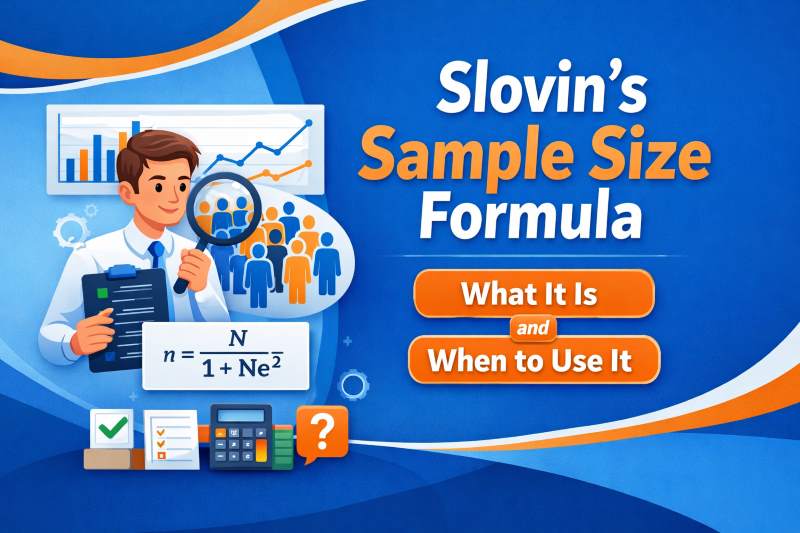
Slovin’s formula is a simple method used to determine the minimum sample size needed for a study. Researchers use it when the total population size is known, but there is little information about the population’s behavior. Instead of collecting data from the entire population, the formula helps estimate how many respondents are enough to obtain reliable results while controlling the margin of error.
In this article, you will learn what Slovin’s formula is, how the formula works, when to use it, and how to apply it to calculate sample size in research studies. You’ll also find practical examples to help you understand how the formula works in real research situations.
What is Slovin’s Formula?
Slovin’s formula is a simple method used to estimate the sample size from a known population. It was founded in 1960 by Robert Slovin. The formula helps researchers determine the minimum number of respondents they should include in a study.
Researchers use this formula to control sampling error and obtain results that reasonably represent the population. The formula works well when researchers do not know the population variance or proportion.
Many students and researchers use Slovin’s formula in survey studies, theses, and dissertations. It is popular because it is easy to apply and requires only the population size and the margin of error.
Slovin’s Sample Size Formula
Slovin’s formula provides the easiest way to calculate the minimum sample size for your study. The formula is n = N/(1+Ne2)
Where:
- n = minimum sample size
- N = population size
- e = margin of error (level of precision)
The margin of error shows how much sampling error the researcher is willing to accept. A smaller margin of error usually requires a larger sample size.
Common margin of error values include:
- 0.10 → 10% margin of error
- 0.05 → 5% margin of error
- 0.01 → 1% margin of error
Example
Suppose a researcher wants to study the satisfaction of students at a university. The total number of students in the university is 3,000. The researcher chooses a 5% margin of error (0.05). Find the minimum sample size for this study.
Solution
By definition, the Slovin’s formula is n = N/(1+Ne2)
From the question, we know that the population size, N = 3000, and the margin of error, e = 0.05
Substituting the values in the formula, we have:
n = 3000/(1 + 3000 * 0.052)
= 3000/ (1+7.5)
=352.94
Since the sample size must be a whole number, we round up to 353
Therefore, the researcher should survey at least 353 students to obtain results that represent the population with a 5% margin of error.
When to Use Slovin’s Sample Size Formula
Researchers use Slovin’s formula when they need a quick way to estimate sample size, and only basic information about the population is available. The formula works best under specific conditions.
- The population size is known. You must know the total number of individuals in the population.
- Population variability is unknown. The variance or population proportion is not available.
- You want to control sampling error. The researcher selects a margin of error to define the desired level of precision.
- Simple random sampling is planned. The formula assumes that each member of the population has an equal chance of selection.
Limitations
While the Slovin’s formula provides a quick way to estimate sample size, it has several limitations. These include:
- Assumes simple random sampling. The formula works best when each member of the population has an equal chance of selection.
- Does not account for population variability. It ignores factors such as variance or population proportion that may affect sample size.
- Less precise than advanced methods. More rigorous formulas, such as Cochran’s formula or power analysis, often produce more accurate estimates.
- Not suitable for complex research designs. Studies that involve stratified sampling, experiments, or multiple variables usually require more advanced sample size calculations.
Frequently Asked Questions
The formula estimates the minimum number of respondents needed for a study when the total population size is known. The result helps researchers collect enough data to represent the population within a chosen margin of error.
Researchers use it because it provides a quick way to estimate sample size. It requires only the population size and the margin of error, which makes it practical when little statistical information about the population is available.
The margin of error reflects the level of precision you want in the results. Many studies use 5%, while exploratory studies may allow 10%. Smaller margins of error require larger samples.
You should only use Slovin’s sample size formula when you know the total population size, and you plan to use simple random sampling.
The calculated sample size (n) represents the minimum recommended number of respondents. You should aim to collect slightly more data to account for non-response or incomplete questionnaires.
Yes. Other approaches include Cochran’s formula, Yamane’s formula, and statistical power analysis. These methods often provide more precise estimates for complex studies.
Reference
Slovin, E. (1960). Slovin’s Formula for Sampling Technique. https://prudencexd.weebly.com/